QUÉ EMOCIÓN!!! PARTICIPAMOS EN UN CONCURSO!!!

XIV PREMIOS ESPIRAL - ACEPTAN NUESTRA CANDIDATURA DE PARTICIPACIÓN PARA LA EDICIÓN 2020

Hemos sido aceptados para participar en la modalidad de ABP en los XIV Premios Espiral. Os imagináis poder lograr tan prestigioso galardón?...

Wednesday, 20 December 2017

The Sans Culottes - Battle of Chacabuco

Our Great Spanish Empire Crumbles

The battle of Chacabuco has been the starting point for the independence of Chile

Monday 17th of February, 1817
Madrid, Spain

Rafael Maroto
The battle of Chacabuco took place on Wednesday, February 12, at a 55 km hacienda in the city of Santiago, which took place between 11 am and 2 pm, two days ahead of schedule, so as not to give time to the forces realistic to reorganize, after several attacks in a row.


The Army of the Andes of the United Provinces of the Río de la Plata led by General Capitain José de San Martín defeated the spanish force led by Rafael Maroto. It was a defeat for the royalist government established after the division of the Viceroyality of Peru.


General Capitain José San Martin
The forces sanmartinanas were divided in two, the right wing led by the argentine general and politician Miguel Estanislao Soler and the left wing by Bernardo O'Higgins.

They were determined to converge for the battle, but in the end the plan was not executed that way. O'Higgins, who logically when advancing by the shortest way, arrived first, with the mission to contain the enemies until the arrival of Soler. He attacked without waiting for Soler's arrival. While the battle was very committed for the criollos, the personal intervention of San Martin began to turn the battle of Chacabuco into a symbol of victory for the patriotic cause.
The arrival of Soler, definitely changed the direction of the meeting, since the surprise attack of this division, left the realists surprised and helpless.


The Spanish losses, amount to 500 dead men and 600 prisoners. As a booty of war, 100 rifles, two pieces of artillery and flags were taken. Emancipating forces killed 12 people and wounded 120. The governor of Chile, the spanish governator, Marcó del Pont, tried to flee to Valparaíso, but has been taken prisoner.

Video about the battle: part 1 and part 2

Tuesday, 19 December 2017

The executioners Unit 3

                                                              17th december 1833-Madrid-Spain   

              WAR BETWEEN FAMILY!

The Carlist and the liberals fight to take their king at the top of the power.


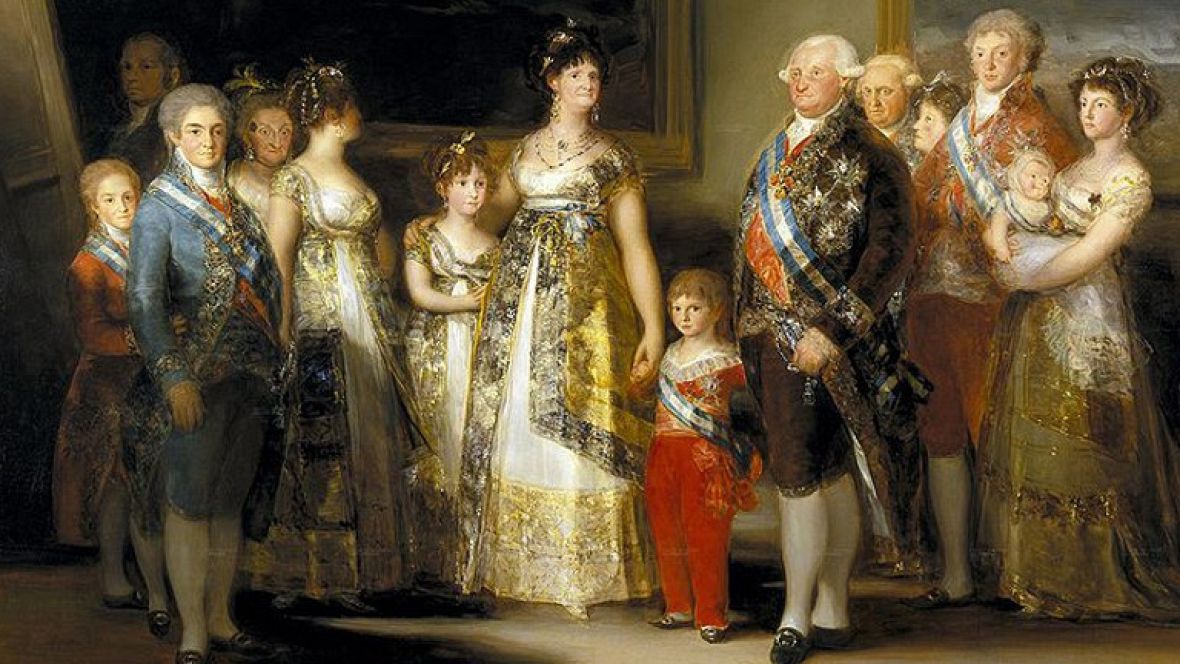
The Family Of Carlos IV
After the death of our king, Ferdinand VII, on 29TH September  and the declaration of the pragmatic sanction to make his daughter heir to the throne as previous years in the reign of Felipe V approved a law that prevented women from inheriting the crown. The question of the succession is not only a dynastic matter, it is also political. It has caused that Carlos Maria Isidro, brother of the king, is in disagreement with this new decree together with a certain social group called the Carlists who supported the thoughts of Carlos.

The war between supporters of Isabel II (liberals) who have thoughts that advocated individual liberties such as right of life and freedom that are opposed to the absolutist thoughts of the Carlist. Isabell II has gained support in the high classes of the Spanish army, the church and the state. The Carlist force was made up by all who have refused the liberal Revolution: small rural nobility, lower clerics, and many farmers that believed in the increase of the taxes by the liberals.
Resultado de imagen de la primera guerra carlista
The First Carlist War

Nowaday Maria Cristina Bourbon reigns as a regent until her daughter Isabel II reaches the age of mayority. 
Due to Carlos' fury he declared war on the legitimate queen and her supporters doing so The First Carlist War, to impose the idea of and absolutist monarchy and his arrival on the throne with the help of the conservatives. 

Which of the two ideas will win?
The liberalism or the carlist?


Sunday, 10 December 2017

UNIT 3 - THE RESTORATION: LIBERALISM AND NATIONALISM: PART 2

Here you have the second part of the unit. The contents are related to the situation of Spain during the reing of Fernando VII and Isabel II, and also to the period kown as Democratic Sexenium. We are also going to study the Latin American process of independence. Let´s enjoy it!!


CLICK HERE FOR GOOGLE DRIVE ACCESS

The whole XIX century is rewieved in the next video. You will find content related with the past unit, but also with the current one and the next. So that, keep this video on mind because is very useful for study contents for different units.

Monday, 20 November 2017

CONTENTS UNIT 3 - THE RESTORATION: LIBERALISM AND NATIONALISM

This new unit is divided in two parts. Here you have the first one, related to The Restoration and the emergence of the liberalism and nationalism in Europe during the first part of the 19th century. You can consult and download the contents included on the presentation, but also you can enjoy the Flipped Class of Mrs. Isabel in the next video!!


Saturday, 18 November 2017

GROUP 1 - UNIT 2

The End Of  "The Terror"


The last 9 of termidor (27 of July) the Jacobin Maximilien Robespierre who exerted the power over France has been executed by guillotine. 


Resultado de imagen de ejecucion robespierre
Guillotine for Robespierre.

The French Republic was passing through difficult moments because the leader of the Jacobins, Maximilien Robespierre, was exerting his power and killing around 40000 people. Because of this on the afternoon of the 9th of termidor (27th of July) he was acussed of tyranny and  was arrested with his allies Saint-Just and Couthon and his brother Augustin Robespierre under the Convention . They were freed by the Comuna of Paris at night. The next day they were imprisoned with the leaders of the Comuna who supported them. They were declared to be acting illegally and they were guillotined the 10th of termidor (the next day) without a trial.                                                           


FLIPPED CLASSROOM!!

In recent times, a series of teachers have been encouraged to record their classes so that after we can see them from home; here I leave some videos related to the contents we have studied.

Group 5, Unit 2 - Storming of the Bastille


STORMING OF THE BASTILLE

Paris, 14th July of 1809


Today ten years ago since the Bastille prison was taken by the Parisian militia. The cause of this was the waste made by our previous king, Louis XVI, both in armed conflicts, like the war of the Independence of the United States and the Seven Years' War, as in the Royal Court. Because of this background, France was in an enormous economic crisis. 

The king advised by the finance minister, Jacques Necker, accepted the representation of the Third Estate. The third state asked for a new system in which each representative would vote individualy. The king refused, but then he was forced to accept the authority of the National Assembly, an institution that was looking for a constitution in France.


On July 11, 1789, Louis XVI dismissed Jacques Necker from his post. Liberals feared that the king's troops closed down the National Assembly, so citizens from all over France swarmed in Paris. There were several revolts in Paris until July 14, the day the storming to the Bastille was made. 
 The citizens gathered at the Bastille began the attack at eleven o'clock in the morning. The attackers mainly sought to seize the large number of weapons and ammunition stored. 
After six hours since the arrival of the Liberals, the warden of Launay, who was commander of the monarchical guard, ordered the ceasefire at 5:00 p.m. The garrison of the Bastille surrendered the arms, under promise to the mutineers that no execution would take place if the capitulation took place. The demanded demands were rejected, but de Launay surrendered the place because he understood that his troops could not resist much longer in that situation and opened the doors of the inner courtyard and the Parisians took the fortress towards five thirty in the afternoon.
 They released the seven prisoners imprisoned there and seized the gunpowder and the ammunition. This was the event that marked the beginning of our revolution.


A short video about the Storming of the Bastille here.

3rd of December 1804

NEWS; POLITICS:

THE NEW EMPEROR OF FRANCE

Changes are coming in France


Resultado de imagen de napoleón emperador
Napoleon
Yesterday, Napoleon Bonaparte obtain the last step of his prestigious career by crowned himself as Emperor of France with the support of the most of the population, in the Cathedral of Notre Dame, in front of Pope Pius VII, all the high French clergy and the highest representation of the political and aristocratic society of France and Europe.


Coronation in the cathedral
This  ascend to power began the 15th of August of 1769, in Ajaccio (Corsica) in a middle class family when he was born. At the age of 16 he join the army and thanks to his habilities he was promoted to ascend to captain, then to commander and finally to general due to his great strategies. After fought and won in several battles in Italy (Lodi, Arcole and Rivoli), in Austria, in the Netherlands and in Egypt, Napoleon became one of most important men in France. When he return, he saw that the Directory was unstable and incompetent he join to Sieyès and Ducos and organised a coup d'etat on the 9th of November of 1799 (18th  of Brumario in the French Republican Calendar).

Resultado de imagen de napoleon gobierno general
Napoleon as general of the French army
They formed a new institution called the Consulate. The office of consuls was held by Napoleon, and Sieyès and Ducos temporaly, until the 12th of December, when Sieyès and Ducos were replaced by Jean-Jacques-Régis de Cambacérès and Charles François Lebrun, who  maintain the position until the past 28th of may, when Napoleon declared himself emperor of France saying: "I'am declaring myself emperor to finish with the Revolution and to improve the french society".


In the street the people seems to be happy with our new great leader Napoleon and we  only hope that the changes he promises  in his declaration come with a period of stability, equality and freedom in our country and if it is possible without more wars at least in a period of time.


Sunday, 12 November 2017

THE PATRIOT

We are going to watch in class the movie "The Patriot". It is an adventure set in the American War of Independence that will help us to better understand what we have studied about that historical episode.

But we are not only going to see the movie, but also, we are going to investigate a bit. You must complete the questions and tasks that you can see in the dossier that follows (you can download it, print it or see it from the computer), and give me a report that includes the result.

At the end of this post, you can also see the rubric with which I will evaluate the exercise.


And here you have the Rubric:


Wednesday, 8 November 2017

GROUP 2 - UNIT 2

Napoleon's return


The greatest emperor of Europe returns from Elba with a great army.
Napoleon, the great emperor who lost everything after a prolific ten year reign and being one of the greatest emperor of Europe, conquering it almost in its totality, is back to action.


As you know, in 1812, thinking that Russia was plotting an alliance with England, Napoleon launched an invasion against the Russians that eventually ended with his troops retreating from Moscow and much of Europe uniting against him. In 1814, Napoleon’s broken forces gave up and Napoleon offered to step down in favor of his son. When this offer was rejected, he abdicated and was sent to Elba.

Almost a year ago, on April 20, 1814, the dethroned Emperor left France for the isle of Elba, where he was exiled under the terms of the Treaty of Fontainebleau. Napoleon would be allowed to rule Elba, which had 12,000 inhabitants. Perhaps cruelly, the treaty allowed him to retain the title "Emperor." On May 4 1814, Napoleon, now 45 years old, arrived at Elba's capital, Portoferraio. Saying, "I want to live from now on like a justice of the peace," Napoleon actually worked hard to improve Elba, and to all observers, it seemed as though Napoleon was content to a life of relative retirement. All the while, however, he was plotting his return to Europe. On Elba, Napoleon was under the constant watch of Austrian and French guards. Nonetheless, he was not isolated: he received thousands of letters from all over Europe and read major newspapers that kept him abreast of events throughout the world.


On February 26, 1815, after less than a year in exile, Napoleon escaped Elba and sailed to the French mainland with a group of more than 1,000 supporters. On March 20, he returned to Paris, immediately, people and troops began to rally to the returned Emperor. French police forces were sent to arrest him, but upon arriving in his presence, they kneeled before him. Triumphantly where he was welcomed by cheering crowds. The new king, Louis XVIII, fled. All his old supporters kneeled... his reign is back now, and what will happen is uncertain. Some people say that a war is coming.

MOST POPULAR POSTS