QUÉ EMOCIÓN!!! PARTICIPAMOS EN UN CONCURSO!!!

XIV PREMIOS ESPIRAL - ACEPTAN NUESTRA CANDIDATURA DE PARTICIPACIÓN PARA LA EDICIÓN 2020

Hemos sido aceptados para participar en la modalidad de ABP en los XIV Premios Espiral. Os imagináis poder lograr tan prestigioso galardón?...

Wednesday, 13 March 2019

The 4 Enlighteners Unit 3

50 YEARS OF MYSTERY

Can you find the murderer?


General Prim
Today, December 30th 1920, we look backward to El Turco street, where fifty years ago took place the mysterious murder of General Prim. The facts still situate us on one of the strangest crimes in all the spanish history. His death caused a weakness in the government of Amadeo of Saboy and led into his abdication. Let's review the events.

Everything happened in a cold winter afternoon. Prim was travelling to the congress when suddenly a catastrophe took place. An unknown group of people was getting closer to his carriage with clear intentions:

willing to everything to end with his life. It occured very fast, according to the witnesses, they entered in the chariot when it stopped, and started shooting. He got injured on his left arm and immediately transported to his house in Madrid, where a doctor took care of him, but it was too late. 
Prim had died apparently due to the bullet wounds. However, there is a second theory supported by scientific studies which have discovered that Prim could have died by a breath constriction after the assault.

Francisco Serrano
Although 50 years have passed, it remains the doubt of who killed him. On one hand, as Prim wanted Spain to be a constitutional and parliamentary monarchy, he gained the republicans' hostility. Also Prim did not want a Bourbon to be the government head and Duke Montpensier believed himself worthy of the crown, so Prim gained more enemies. The main suspect was Francisco Serrano, who wanted to be King of Spain but Prim wanted a foreign king and refused to trust Serrano despite having spent a lifetime working together, but... who do you think is responsible for this mysterious murder?


Monday, 11 March 2019

DIDEROT NEWS: UNIT 3


THE END OF THE LIBERALS IS COMING

May 26, 1823

Ferdinand VII about Angouleme said: "My august and beloved cousin, the Duke of Angouleme, leading a brave army, winner in all my domains, took me out of the slavery in which he moaned, restoring my beloved vassals, faithful and constant"

Last Saturday, May 24th, sixty thousand soldiers and the same number of mercenaries crossed the cities and fields of Spain until they reached Madrid.


They came from France to put an end to the Liberal Triennium and return the power to Ferdinand VII. 


It seems that there were 95062 men and they called them one hundred thousand, to give 

a round number.

In this flowerish May and the struggle that we are living, the invasion of the 100000 Sons of Saint Louis supposes a good business for everyone, except for the common people that suffer its attacks.


Resultado de imagen de 100000 hijos de san luis
"100000 Sons of Saint Louis arrive to Spain"

The Duke of Angouleme was in command of the invading army. He had left France with his parents in 1789, due to the Revolution, to save their lives.

His army was endowed with five corps, unlike the Spanish constitutional army, which consisted on four corps of 20,000 men each. In total 130,000 soldiers, who were more than one hundred thousand. But the lack of organization, the low moral and short number of soldiers took the Spanish army to its failure.

The English aid that was expected did not arrive on time and only the National Militia offered resistance. 

The liberals expected the French invasion and finally, with the defeat in the battle of the Trocadero, the Liberal Triennium ended.


The MIlitia 3-4

THE PAINTED REVOLUTION


The French artist Éugene Delacroix has just released his new masterpiece "The Liberty Leading the People" based on the revolution of 1830 that ended with the absolutism of Charles X.

Eugène Delacroix (click here for a more detailed biography), born in 1798 (Paris) is one of the greatest artists nowadays. In contrast to the Neoclassical perfectionism of his chief rival Ingres, Delacroix took for his inspiration the art of Rubens and painters of the Venetian Renaissance.

This painting has to do with the revolution we have suffered last  27th July 1830.

THE PICTURE

Analysis of the painting:


This picture is painted in oil on canvas; it has romanticism style, sided 260cm x 325cm. 
The main character, The Liberty, is represented by a half-naked woman in the middle centre of the battlefield : Marianne.

Other characters are:
The three social clasesrepresenting the town as a whole.
The fallen: Those killed are exposed above the rubble of an explosion.
The people: stand with their arms raised, symbol of the revolution, and follow their guide: their own freedom.

The Second French Revolution (Trois Glorieuses). This revolt broke up because of the absolutist policies of Charles X. It consisted of three glorious days in which the french people fought against the king (from 27th to 30th July). The 30th July they achieved to overcome against the absolutism and the inequalities leading to a revolutionary period that will be followed by many other nations. Th
is revolution forced the king to abdicate and the assembly chose Louis Philippe I of Orleans.


Tuesday, 26 February 2019

Liberal News:The First Spanish Republic


The republic has already been in force for a year!!


The First Spanish Republic is bringing to light the differences between its own defenders and the limited popular support.


After the Glorious Revolution (1868), Isabel II lost her power and she wasn´t Queen of Spain anymore. After that a Provisional Government was established (during the 1868 and 1870) and the General Serrano was the regent. 

General Serrano

Serrano and Prim decided to put Amadeo of Savoy (Son of Victor Emmanuel, King of Italy) as king of Spain, but he only governed during a year and a half. He abdicated and returned to Italy, so the Cortes proclaimed the First Spanish Republic.


Now talking about the beginning of the republic, it  was a very instable period  since the republicans didn´t have the same concept of it  .This instability was also reflected on the fact that in this year there were four different presidensts. 


The most important one was:


Francisco Pi y Margall

Francisco Pi y Margall ,  the second president of the republic. He was a politic with federal ideas and also was a journalist. During his governement he opposed the Third Carlist War,  the Cantonal Revolution, some problems in Cuba and he advocated the proyect of the federal constitution.


Not only Francisco Pi y Margall had to face many problems but also all the Republic in general. Some of them were:


-The Carlists: they were angered because wanted a Carlist to be the next monarch and the parliament choosed Amedeo of Savoy. When the Republic started the Third Carlist War was happening.

-Monarchists:They were the supporters of Alfonso XII.They wanted the return of the borbons to the Spanish throne.
- The division of the republic: the republicans were divided into two parties, depending on their concept of republic;  the federals and the centralised.
-Problems in Cuba: it was a revolution in Cuba in order to obtain more autonomy.


Nowadays the Cortes had been disolved by general Pavía and the past month of December General Serrano proclaimed himself as the new president of Spanish government after this year of big instability.


Monday, 18 February 2019

THE ROYAL FAMILY: UNIT 3

THE ATTEMPT ON AMADEO OF SAVOY

Two days ago the king Amadeo Of Savoy was walking  through Madrid, when he suffered an attempted attack... 

20/7/1872

Two years after General Prim was killed and our king was left without any political support, Amadeo of Savoy has suffered an attempt on his life last 18th July. It happened in Arenal street in Madrid while he was having a walk. Although he was warned by Mata, who had heard about some people who wanted to kill Amadeo, through his friend Topete, Amadeo refused to change the route.

Amadeo of Savoy
The king was on his coach with his wife Victoria del Pozo and the General Burgos, and suddenly, some men shot them. Luckily, nothing happened to our king. And the aggressors ran away though the S.Maratín street, when they saw how their attack failed.
In their escape, one of them was shot down.

After this, the inspectors have pointed Prim´s murder have been an atempt of the same characteristics.
And the main question is: who really was behind?

 There are too many suspects as he has a lot of enemies. Since Amadeo took the throne through the parliament , so anyone may have reasons to hate him: 

-The carlists

-The republicans

-The church (for being the son of the monarch who closed down the papal states)

-The population, didn´t even accept him for his difficulties to learn our language.

Bravely, our fearless king went out the next day to prove he wasn't scare of anything!


Thursday, 7 February 2019

NOTICIÓN!! HEMOS SIDO NOMINADOS!! WE HAVE BEEN NOMINATED FOR A PRICE!!

Hoy nos hemos despertado con la noticia de la nominación de nuestro proyecto para la II Edición de los Premios de Innovación Educativa!!! Enhorabuena por vuestro trabajo!! Aquí podéis ver el artículo del Diario de León y, desde mañana, podéis votar on-line a través del siguiente ENLACE PARA VOTAR!! Solo tenéis que buscar la categoría IMPULSO DE ENSEÑANZA MULTILINGÜE,  y pinchar en el cuadro de VOTAR. Después, obviamente, elegís la opción IES ORNIA. Las votaciones son hasta el 13 de febrero de 2019. COMPARTE ENTRE TUS CONTACTOS Y AYÚDANOS A GANAR! GRACIAS!

VOTACIÓN ‘ON LINE’

‘The Historical Newspaper Project’, del Ornia, finalista en innovación educativa
El ‘Historical Newspaper Project’, un periódico en el que los hechos históricos se convirtieron en noticias en el IES Ornia de La Bañeza, ha quedado finalista en los premios de Innovación Educativa 2019 como reconocimiento al impulso de la enseñanza multilingüe. El proyecto, dirigido por el profesor Óscar González, entra a partir del día 7 en la carrera por el premio en una votación on line, primero, y una valoración final que realizará el Claustro de Expertos. Aunque el apoyo popular que se recoja no es vinculante, sí es importante para todos los centros finalistas.

marciano pérez -

Wednesday, 30 January 2019

The 4 Enlighteners Unit 1-2

Do you really know Napoleon?


Today is the 2nd December 1804 and the coronation of the famous military leader, Napoleon Bonaparte is going to take place at the cathedral of Notre-Dame in Paris. The ceremony will be held by Pope Pio VII,who has been travelling from Italy for 3 weeks to attend this succesful celebration. Lot of prestigious nobles and wellknown people are invited to the event. Along his walk, Napoleon has been climbing up through the Directory and the Consulate. It looks like Napoleon is trying to reaffirm himself as the head of the country.


But, do we really know our future emperor? Below, we give a more earthly point of view about him.


Napoleon, also known as Nabulio, was a brilliant student who accepted the challenge of becoming a military soldier. Although he faces powerful armies his biggest fear is cats, but it isn´t his only fear: he hates looking at open doors. Between his hobbies we can find the yoyo and the chess. He thinks sleeping is for weak people and he always carries with him a bottle of poison in case he gets captured in a battle.


Now we know the truth and the facts, we can find the character of Napoleon and how megalomany is affecting him.

Is he the emperor we want to represent our country?


Liberal News - Unit 1-2

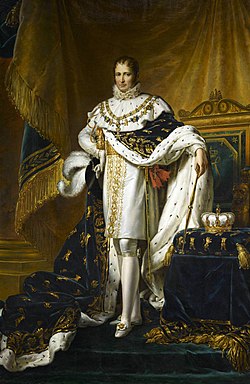
Joseph I new king of Spain


The past 6th of June, Joseph Bonaparte was proclaimed king of Spain.


Joseph I Bonaparte, the older brother of the emperor Napoleon Bonaparte of France and the former King of Naples become king of Spain after been proclaimed by his brother in the abdications of Bayonne.


Napoleon obtained the Spanish permission to cross the country to invade Portugal. Also his intention was to invade Spain.

In the Revolt of Aranjuez, the Royal Family tried to escape from Madrid. Napoleon forced Carlos IV and Fernando VII to abdicate in favour of him and made his brother king of Spain.

Joseph imposed a Constitution with enlightened reforms such as liberty and equality for all citizens.

Resultado de imagen de pepe botella king
Joseph I of Spain


The king granted us an interview and we asked him about his political ideas and he told us that we wanted to establish a constitutional monarchy in Spain, we wanted to impose a new constitution based on:
  • The separation of powers.
  • Removal of internal customs. 
  • Inviolability of the address. 
  • Personal freedom. 
  • Rights of the detainee and prisoner. 
  • Abolition of torment (related to physical and moral integrity).

The citizens are unhappy with the new king because he is French and they have started to stir up and to put him derogatory nicknames such as "Pepe Botella".Since rumors that Joseph I is alcoholic are appearing. The people also put him "Plazuelas", because he want to create well-known public spaces.


Sunday, 27 January 2019

HISTORICAL NEWSPAPER PROJECT!! THE RETURN!!

Well, this year we started work late for reasons that do not matter, but we are already working with a new group of 4th ESO in the 2nd edition of the IES Ornia´s Historical Newspaper.

I want to take the opportunity to remember the news of the conclusion of the last course´s project, with the printed edition and the visit to the facilities of Diario de León.

The rotaries are underway and soon we will be able to enjoy the new historical news !!! Be patient!

_________________________________________________________________________________

Bueno, este año empezamos el trabajo tarde por causas que no tienen importancia, pero ya estamos trabajando con un nuevo grupo de 4º de ESO en la 2ª edición del Historical Newspaper del IES Ornia.

Quiero aprovechar la oportunidad para recordar la noticia de la conclusión del proyecto del curso pasado, con la edición impresa y la visita a las instalaciones del Diario de León.

Los rotativos están en marcha y pronto podremos disfrutar de las nuevas noticias históricas!!! Tened paciencia!

_________________________________________________________________________________

El ‘Historical Newspaper’ se pasa al papel

El IES Ornia de La Bañeza imprime uno de los diarios elaborados por el alumnado de 4º C de ESO bilingüe.


El alumnado de 4ºC de ESO del IES Ornia en su visita a Diario de León. RAMIRO -
El alumnado de 4ºC de ESO del IES Ornia en su visita a Diario de León. RAMIRO.
30/06/2018
ANA GAITERO | LEÓN
En los tiempos en los que el papel, periódico, está amenazado de muerte, va un instituto leonés, bañezano para más señas, y apuesta por el periodismo impreso. Y no sólo porque allí se lea el Diario de León o porque el alumnado de 4º C de ESO bilingüe visitara sus instalaciones hace unos días. Sobre todo porque este curso del IES Ornia puso el broche de oro a su proyecto de aprendizaje de la Historia a través de un periódico en el que han relatado acontecimientos como la teoría de la gravedad, la liberación de París en 1944 o la muerte del fascista Mussolini en forma de noticias. El centro educativo consideró que era una buena manera de cerrar el proyecto de The Historical Newspaper Project, que tanta repercusión ha tenido incluso a nivel nacional, llevando a cabo una edición impresa del mismo.
El profesor de la asignatura, Óscar González García, explica en el editorial que se planteó el proyecto de crear un periódico histórico con el alumnado como una forma de «salir de la rutina de la clase de Historia».
Sus alumnos y alumnas se quedaron perplejos, pero luego la sorpresa se la llevó el profesor: «Respondieron a la perfección poniéndose en el papel de reporteros históricos que no dejaron de sorprenderme a lo largo de siete entregas de noticias ¡en Inglés!».
El ejemplar impreso se ha confeccionado además con un ramillete de noticias históricas entre las 35 elaboradas a lo largo del curso. El criterio ha sido que hubiera una noticia por cada unidad didáctica estudiada en clase y al menos una de cada grupo de trabajo.
Se han editado cien ejemplares, que se han repartido entre estudiantes de los cuatro cursos de la sección bilingüe del IES Ornia, profesorado y medios de comunicación. También puede descargarse a través del blog donde se alojan todos los trabajos: http://historicalnewspaper4eso.blogspot.com/.
La clase de Historia abrió las puertas a estos estudiantes a una experiencia única a través de la técnica periodística. El viaje de fin de curso al campo de concentración de Mauthaussen, en Alemania, o la visita al Archivo Histórico Provincial también han sido grandes lecciones de Historia.

MOST POPULAR POSTS